Interior Design Website Revamp with Custom WordPress Development
Revamping a slow interior design website into a fast, responsive WordPress site with consistent design, optimized assets, and a custom shop layout.
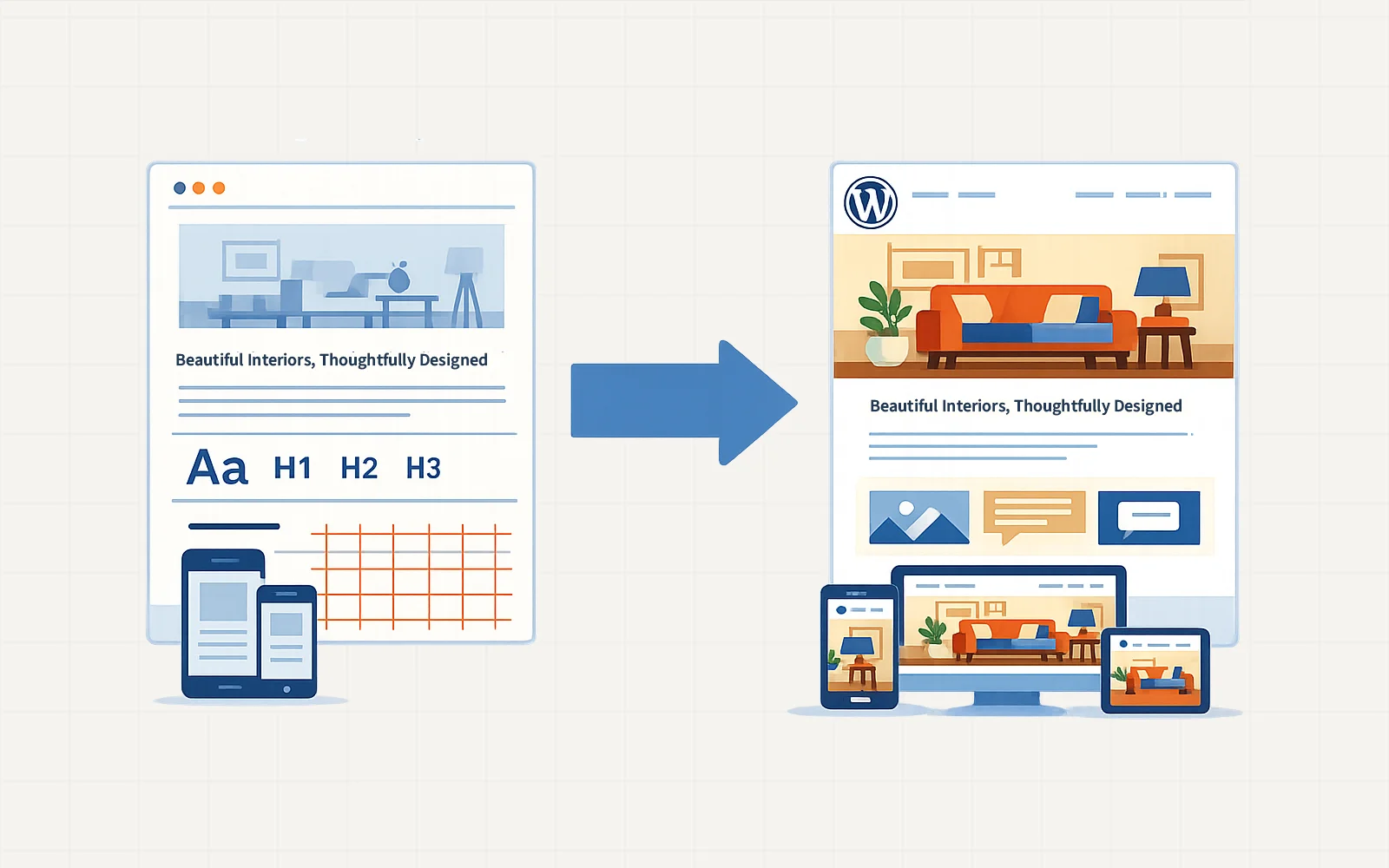
Due to client NDA restrictions, project visuals are represented with simplified illustrations. The architecture and metrics reflect the actual implementation.
Chapters
Project Overview
An interior design business needed to modernize their existing WordPress website. The original site had been built using the Classic Editor and had gradually accumulated inconsistencies, performance issues, and plugin overhead.
The client provided a new visual design and wanted the site rebuilt with a more professional structure while maintaining full control through WordPress.
The project also included implementing a shop page with custom layouts and filters for showcasing products and design items.
The goal was to create a faster, cleaner website that matched the provided design exactly while improving long-term maintainability.
Initial Site Assessment
Before beginning development, I reviewed the existing website and found several common issues often seen in older WordPress builds.
These included:
• excessive plugins performing overlapping tasks
• multiple image optimization plugins running simultaneously
• unoptimized media assets
• inconsistent layout structure
• lack of a centralized typography and styling system
The site also contained unused themes, leftover database entries, and other artifacts from previous development work.
Together, these issues contributed to slower performance and inconsistent page layouts.
Preparing the Foundation
Rather than immediately starting the redesign, the first step was to clean and stabilize the existing environment.
This included:
• removing unused themes and plugins
• cleaning up database revisions and transient data
• removing duplicated or unnecessary media files
• updating WordPress core, plugins, and themes
Once unnecessary components were removed, the website already showed noticeable performance improvements even before the redesign began.
Establishing this clean baseline ensured the new development work would be built on a stable and optimized foundation.
Development Approach
The new website was built using the Neve Pro theme as a base, with customizations applied to match the provided design precisely.
Before building pages, I implemented a central style system using custom CSS variables. This created a consistent structure for typography, spacing, and color usage across the entire website.
Having this centralized style guide helped maintain consistency throughout development and made future updates easier to manage.
Design Implementation
The homepage was developed first as the primary template for the site’s visual system.
Once the client reviewed and approved the homepage, the remaining pages were implemented following the same structure and styling system.
In total, 12 custom-designed pages were created within seven working days.
During development, particular attention was given to:
• consistent spacing and typography
• accurate conversion of the provided design
• responsive layouts across devices
• optimized media assets
Images were resized and exported in modern formats such as WebP to reduce page weight, and logo assets were converted to SVG for improved sharpness and scalability.
Shop Page Implementation
The website also included a shop section for showcasing design-related products.
A custom layout was created to ensure the shop integrated seamlessly with the overall design. Filtering and layout structures were configured to make browsing easier while maintaining visual consistency with the rest of the site.
Responsive Testing
Responsiveness was tested continuously throughout development.
Layouts were reviewed across:
• mobile devices
• tablets
• laptops
• desktop displays
This ensured the final result maintained the same visual quality and usability regardless of screen size.
Performance Optimization
Performance improvements were a key objective of the project.
Several optimizations were implemented during development:
• modern image formats and proper sizing
• reduced plugin dependency
• streamlined asset loading
• simplified layout structure
As a result, the website achieved strong performance scores.
Results
After launch, the website delivered significant improvements compared to the previous version.
Google PageSpeed results improved to:
Mobile performance: 85
Desktop performance: 90
Other quality metrics also scored highly:
Best Practices: 100
Accessibility: 96
Beyond measurable performance gains, the new website provides a much more professional and consistent experience while remaining easy for the client to manage.
Long-Term Impact
With a cleaner architecture, optimized media assets, and a centralized styling system, the website is now easier to maintain and expand in the future.
The improved performance and consistent design also provide a stronger digital presence for the client’s interior design business.
The client, Carolina, was very satisfied with the result and expressed interest in collaborating on future projects.